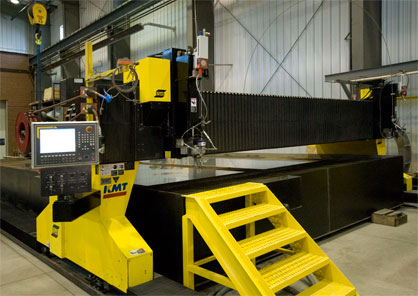
Water is able to erode significant amount of land over time. Every time a wave hits the shores, a small amount of the land erodes into the ocean. Waterjet cutting can be seen as a similar process but much more concentrated. High amount of pressure (usually anywhere between 30,000 PSI to 90,000 PSI on a typical waterjet machinery) is applied to the water, which causes it to shoot as a narrow jet when pushed through a small hole. This causes the water to hit the material being cut with such tremendous force that the material basically starts to disintegrate at the point of contact.
As the force of the water is continuously applied to the material it will eventually make its way through the said material. When you move the material at the same pace it is being punctured through, it will start to produce a clean cut. Waterjets are basically amplification of what already occurs naturally in nature. Even a single drop of water can create a hole on a rock if enough time passes by. Waterjet produces same results in a much shorter time span by increasing the pressure. To simply put, higher pressure means less time required.
When you examine natural erosions, you would see that the end results are very smooth. When waves hit the rocks by the shores, the rocks become more smooth and round as time passes. Drops of waters falling on a rock will also produce a very smooth holes or cuts after decades or even centuries have passed. Waterjets are able to cut thick slabs of hard materials such as metal in minutes or even seconds but can be fine adjusted to produce smooth results.
If precision, accuracy and quality is mission critical for the fabrication project at hand, waterjets should be a prime candidate among other cutting methods since the cutting process can be fine tuned to produce the smoothest results. Fitting two parts together when they have jagged edges is virtually impossible. When the materials are cut through waterjet, the end results would so clean that piece will fit together as if they were one.
Waterjets can be seen as the natural way to cutting. While waterjet cutting process requires high amount of water, the water can be filtered and reused. This makes waterjet cutting process more greener than some of its alternatives. Water will also naturally cool the material being cut during the process, which means that there will be no warping or deterioration of the material due to excessive heat.
When you cut through a dense wood using high speed saws, you can often smell burning of the wood. There is no such problem with waterjets since the material being cut is cooled and protected by splashed water. Metals tend to be more sensitive to heat. It can warp, bend or even melt if the temperature gets too hot. Waterjets are able to keep the metals cooled while being cut, making the two an ideal combination. By using waterjets, you will be able to achieve great results without compromising quality.